OutSystems vs Mendix: Scalability and Performance Compared
Compare OutSystems' compiled runtime and auto-scaling with Mendix's JVM model, deployment options, and tuning trade-offs.


If I had to sum it up in one line: OutSystems ODC is the stronger choice for raw execution speed and built-in auto-scaling, while Mendix gives you more deployment options and more hands-on control.
If you’re comparing these two platforms for enterprise apps, here’s what matters most:
- OutSystems uses compiled code, which cuts runtime overhead.
- Mendix runs on a JVM-based model runtime, which can add overhead in larger apps.
- OutSystems ODC auto-scales on Kubernetes and starts with 15 compute instances per stage, with support up to 30 with High Availability.
- Mendix Cloud scales through stateless instances, but a single cloud instance tops out at 32 GiB RAM, so larger loads often mean adding more instances or splitting apps.
- OutSystems 11 supports on-premises, cloud, and hybrid setups, but scaling is more manual.
- Mendix supports cloud, private Kubernetes/OpenShift, and on-premises deployments.
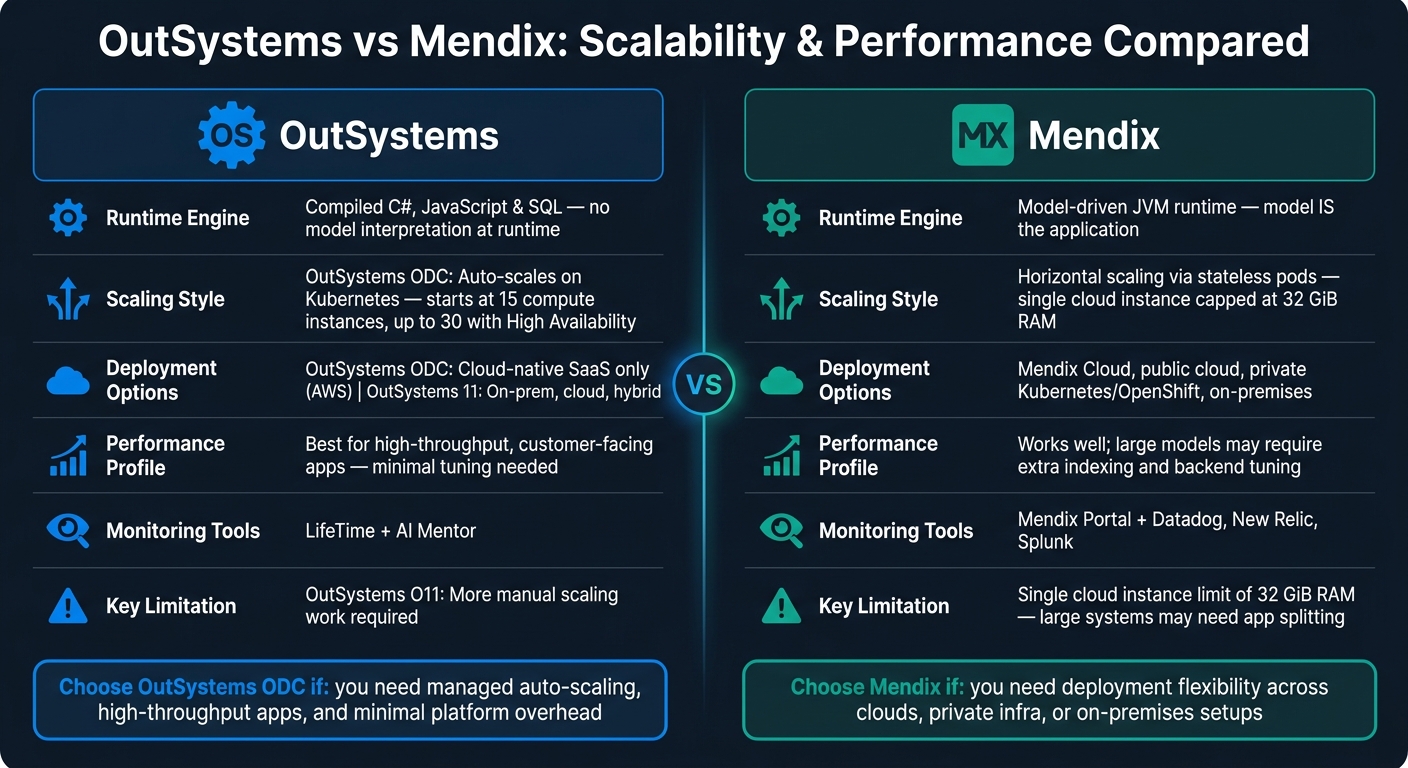
OutSystems vs Mendix: Scalability & Performance Comparison
Outsystems vs Mendix (2026) - Which One Is BETTER?
sbb-itb-fd683fe
Quick Comparison
| Area | OutSystems | Mendix |
|---|---|---|
| Runtime | Compiled C#, JavaScript, and SQL | Model-driven JVM runtime |
| Scaling style | ODC auto-scales on Kubernetes; O11 scales by adding nodes | Horizontal scaling with stateless instances |
| Deployment choices | ODC is SaaS-only; O11 supports cloud, hybrid, and on-prem | Cloud, public cloud, private cloud, and on-prem |
| Performance profile | Strong fit for high-throughput apps | Works well, but larger models may need more tuning |
| Monitoring | LifeTime and AI Mentor | Mendix Portal plus tools like Datadog and New Relic |
| Main limit to watch | O11 needs more manual scaling work | Single cloud instance limit of 32 GiB RAM |
My take: if you want less platform work day to day, OutSystems ODC is usually the better fit. If you need deployment freedom across many setups, Mendix has the edge. The rest of this article breaks down those trade-offs in plain English.
OutSystems: Scalability Model and Performance Profile
OutSystems compiles to C#, JavaScript, and SQL, so apps run without runtime model interpretation. That matters for speed. The platform doesn’t have to “read” the app model while the app is running, which helps cut extra overhead.
OutSystems scales in two different ways depending on the product. O11 leans on managed nodes, while ODC uses cloud-native orchestration. So the deployment model has a big effect on how much elasticity a team gets.
Deployment Architecture and Scaling Options
OutSystems 11 (O11) runs on a stateful server cluster. To scale it, teams add front-end nodes behind a load balancer. O11 can be deployed on-premises, in the cloud, or in a hybrid setup. In plain terms, scaling is possible, but it’s more hands-on.
OutSystems Developer Cloud (ODC) takes a different route. It’s a cloud-native SaaS platform built on AWS with Kubernetes and Linux containers, and apps deploy as independent microservices. Kubernetes handles horizontal and vertical scaling based on load automatically. ODC also uses Aurora Serverless V2 for the database layer. It starts with 15 compute instances per stage and can scale to 30 when High Availability is enabled.
| Feature | OutSystems 11 (O11) | OutSystems Developer Cloud (ODC) |
|---|---|---|
| Architecture | Stateful server cluster | Kubernetes, Linux containers, microservices |
| Scaling | Manual horizontal scaling by adding front-end nodes | Automatic elastic scaling through Kubernetes |
| Deployment | On-premises, cloud, or hybrid | Cloud-native SaaS (AWS) |
| Database Scaling | Manual vertical upgrades | Automatic (Aurora Serverless V2) |
Runtime Performance and Optimization Tools
Because OutSystems compiles to standard code, it avoids the drag that can come with model interpretation at runtime. It also includes automatic resource cleanup, which helps limit memory use and reduce bottlenecks.
Teams can tune performance with a few built-in approaches:
- Query optimization
- Server-side pagination
- Caching
These steps help cut extra database and server load. On top of that, LifeTime brings environment management, performance monitoring, and security policies into one place. AI Mentor helps spot technical debt and bottlenecks early.
Mendix takes a different scaling path, so the next section looks at how its cloud-native runtime behaves under load.
Mendix: Scalability Model and Performance Profile
Mendix runs models directly on a JVM-based runtime, which means the model is the application. That setup helps with consistency and debugging because what you design is tightly tied to what runs in production. The flip side is that very large models can bring some overhead. And that runtime approach has a direct effect on how Mendix scales in both cloud and private setups.
Cloud-Native Deployment and Scaling Behavior
Mendix is stateless between requests, so any instance can handle any request. That makes horizontal scaling pretty simple. It also aligns with the 12-factor app approach.
Teams can deploy Mendix in a lot of places, including:
- Mendix Cloud
- Major public clouds
- Private Kubernetes/OpenShift setups
- On-premises infrastructure
On Mendix Cloud Premium plans, horizontal scaling across multiple Availability Zones and database fallback options are built in. In private cloud setups, teams can manage scaling with the Mendix Kubernetes Operator. That gives them more control, but it also puts more of the architecture work on their plate.
Performance Monitoring and Tuning Practices
Mendix Portal monitoring goes beyond basic CPU and memory data. It also tracks model execution metrics, which makes it easier to spot workflow bottlenecks. If a team needs deeper observability, Mendix can connect with Datadog, New Relic, or Splunk.
A few tuning moves come up again and again:
- Index attributes that are queried often
- Run large jobs asynchronously
- Use nanoflows for simple client-side logic
- Save custom Java actions for backend hotspots
There are also some practical limits to keep in mind. A single Mendix Cloud instance supports up to 32 GiB of RAM, so bigger workloads need multiple instances. For very large systems, teams may need to split work across smaller Mendix apps and connect them through REST or events.
That trade-off stands out in a side-by-side look at OutSystems. Mendix leans toward stateless horizontal scaling, while OutSystems depends more on deployment model and orchestration.
OutSystems vs Mendix: Side-by-Side Comparison
Both platforms scale well. The main difference comes down to how much control your team wants over runtime behavior and deployment.
The execution model is where the gap starts. OutSystems generates compiled code, while Mendix runs on a model-driven JVM runtime. That affects speed, scaling behavior, and how much tuning your team may need to do.
Architecture, Scaling, and Deployment Differences
OutSystems Developer Cloud (ODC) runs on a Kubernetes-based microservices setup on AWS. It comes with automatic vertical and horizontal scaling built in, and your team doesn’t manage containers directly. The platform takes care of orchestration for you.
Mendix uses stateless runtime pods that scale horizontally. So yes, both platforms can scale. But the day-to-day operating model is different.
Mendix gives teams more deployment choice. It supports Mendix Cloud, major public clouds, private Kubernetes/OpenShift, and on-premises infrastructure. ODC, by contrast, is cloud-native SaaS only. If a company needs on-premises or hybrid deployment, it would need to use OutSystems 11 instead.
| Factor | OutSystems ODC | Mendix |
|---|---|---|
| Runtime | Compiled C#, JavaScript, and SQL | Model-driven runtime on the JVM |
| Scaling | Managed auto-scaling on Kubernetes | Horizontal scaling via stateless pods |
| Deployment | cloud-native SaaS only | Multi-cloud, private cloud, and on-premises |
| Observability | AI Mentor System | Mendix APM |
That setup difference shapes the performance trade-offs below.
Performance Strengths, Limits, and Trade-Offs
For high-traffic, externally facing applications, OutSystems is often the better fit for execution speed. Mendix works well for modular modernization projects, but large models may need extra indexing and backend tuning to stay efficient.
In plain terms, OutSystems usually has the edge in execution speed and managed auto-scaling. Mendix gives you more deployment freedom, but very large models can demand more manual optimization.
Those are the trade-offs that tend to matter most when teams are choosing a platform for enterprise growth.
Which Platform Fits Enterprise Growth Better
The right choice comes down to four things: app complexity, expected traffic, deployment needs, and how much control your team wants day to day.
Decision Criteria
The trade-offs above make the split pretty clear.
Go with OutSystems ODC if your team is building high-traffic, customer-facing apps, wants the platform to handle scaling on its own, and doesn't need on-premises or private cloud deployment.
Go with Mendix if your company needs to deploy across multiple cloud providers or in on-premises setups, or leans on fusion teams where business analysts help shape and build apps directly. Mendix scales in a steady way across public clouds and private Kubernetes.
Your team's operating style matters too. OutSystems ODC fits teams that want managed scaling with less hands-on work. Mendix fits teams that want architects to control scaling through the Mendix Operator.
Final Takeaways
Here's the simplest way to separate them:
OutSystems is the stronger pick for managed auto-scaling and high-throughput workloads.
Mendix wins on deployment flexibility and collaborative development.
The decision comes down to matching the platform's architecture to your deployment and scaling needs.
FAQs
Which platform is easier to scale?
Both platforms can handle enterprise growth, but they take different paths to get there.
Mendix is often seen as easier to scale. Its model-driven approach can cut down complexity when you need to expand horizontally or vertically. That can make growth feel less like rebuilding the plane mid-flight and more like adding new parts in a controlled way.
OutSystems, on the other hand, is often the pick for highly complex, mission-critical applications. It tends to stand out when strong performance and reliability under heavy loads matter most. The tradeoff is that it usually needs more technical oversight.
When does deployment flexibility matter most?
Deployment flexibility matters most when your organization has specific hosting requirements, like data sovereignty, regulatory compliance, or the need to connect with systems you already use.
This matters even more for enterprises that need on-premises, private cloud, public cloud, or hybrid setups. It gives them more control as they scale to meet security demands and technical requirements.
How much tuning do large apps need?
For large applications, tuning often comes down to the platform you're using. Mendix usually needs more hands-on performance work as the model gets bigger, especially in large enterprise deployments.
OutSystems is built for high performance, so it often needs less manual tuning. That said, caching, query tuning, and modularity still play a big role once you hit massive scale.
Related Blog Posts
- Gemini 3.1 vs Sonnet 4.6: Performance & Cost Guide
- Best AI Tools for Real-Time Capacity Planning
- Future of Workflow Automation: AI and iPaaS
- Top 7 AI Tools for Production Scheduling 2026
More on StackRundown
Continue on the Software Comparisons hub, or read next: