ISO 27001 or NIST: Which Fits Your Business?
Compare ISO 27001 certification vs NIST CSF to pick the right security framework for sales, compliance, and team capacity.

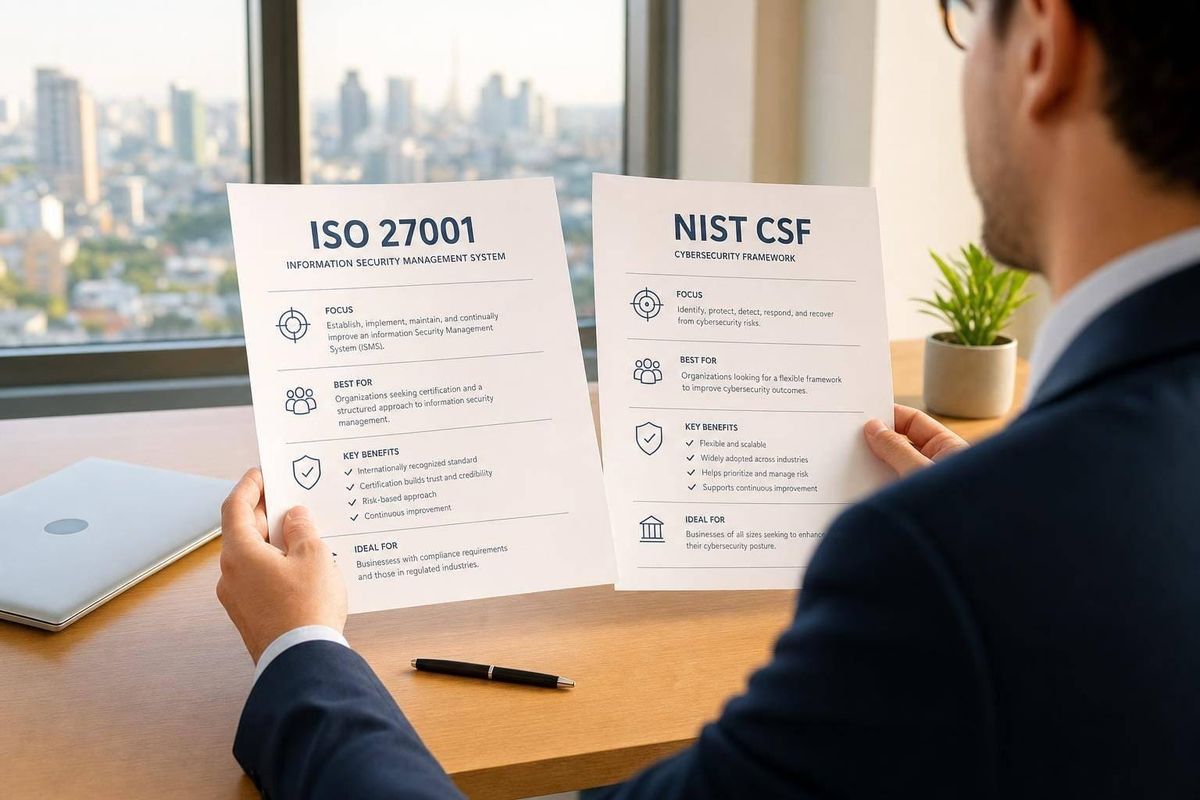
If you need a certificate to help close deals, I’d lean toward ISO 27001. If you need a simpler way to organize security work, I’d start with NIST CSF.
Here’s the short version:
- ISO 27001 is best when buyers, partners, or audits want third-party proof
- NIST CSF is best when your team wants a flexible way to assess and improve cyber risk
- Small SaaS teams often start with NIST CSF
- Enterprise-focused SaaS and AI companies often move to ISO 27001
- Regulated firms often use both
One key fact shapes the choice: ISO 27001 has formal certification. NIST CSF does not. That affects cost, workload, and how much weight each one carries in procurement.
You can also think about it this way:
- Choose ISO 27001 if deals are slowing because customers want a certificate
- Choose NIST CSF if you need a clear starting point without an audit path
- Use both if you want NIST for internal risk work and ISO for outside assurance
Most companies don’t need to guess. They can match the framework to their sales process, team size, and compliance pressure.
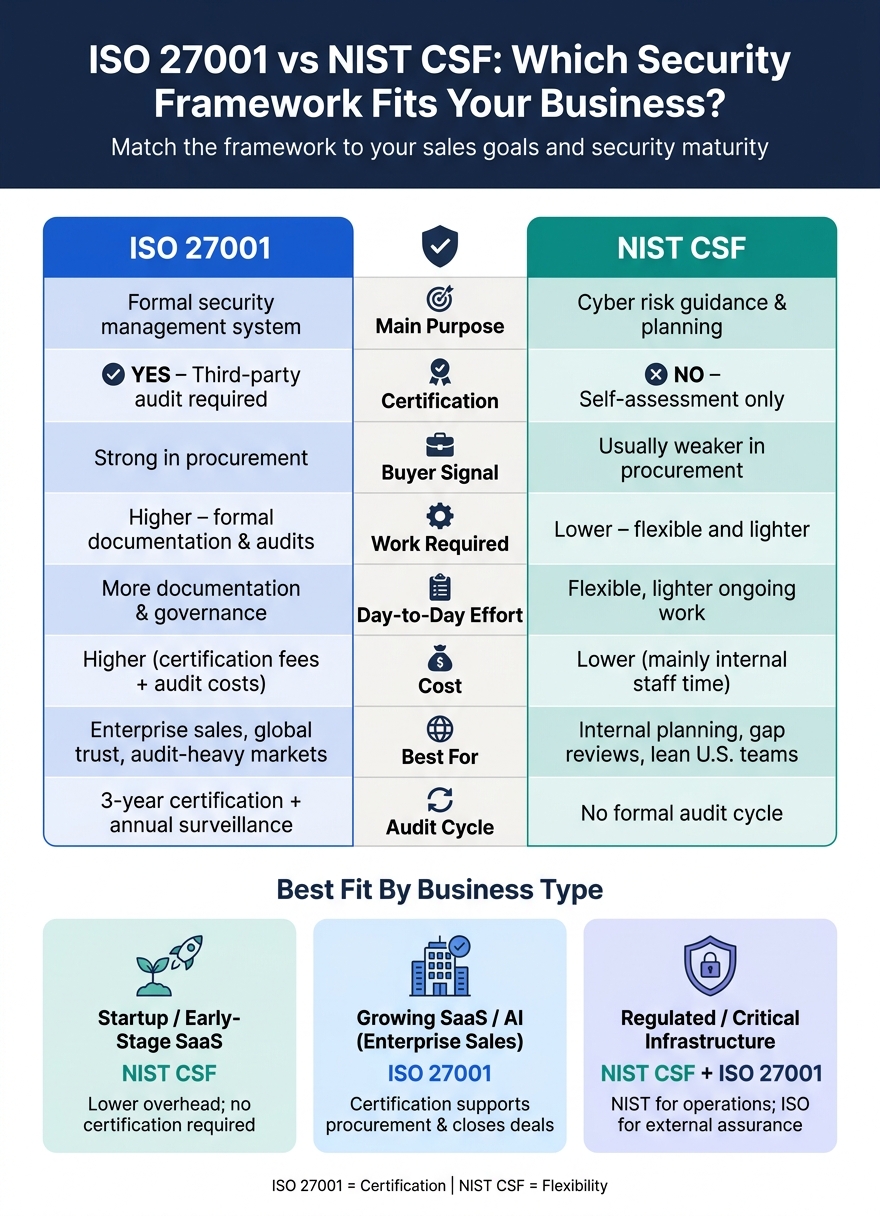
ISO 27001 vs NIST CSF: Which Security Framework Fits Your Business?
ISO 27001 as the Engine, NIST CSF 2.0 as the Dashboard, A Practical Operating Model
sbb-itb-fd683fe
Quick Comparison
| Criteria | ISO 27001 | NIST CSF |
|---|---|---|
| Main purpose | Formal security management system | Cyber risk guidance |
| Certification | Yes | No |
| Best for | Enterprise sales, global customer trust, audit-heavy markets | Internal security planning, gap reviews, smaller U.S. teams |
| Work required at the start | Higher | Lower |
| Day-to-day effort | More documentation and reviews | More flexible and lighter |
| Buyer signal | Stronger in procurement | Usually weaker in procurement |
| Common use case | Proving security to customers | Organizing and improving security work |
In this article, I’d use that lens: buyer pressure, team capacity, and security maturity. That’s usually enough to tell which path fits.
ISO 27001 vs NIST: Core Differences That Matter
Now that the basics are clear, here are the differences that tend to shape actual buying decisions and rollout plans.
| Aspect | ISO 27001 | NIST Cybersecurity Framework | Best Fit For |
|---|---|---|---|
| Certification | Requires a third-party audit and certification | No official certification; organizations self-assess and align controls | External assurance |
| Structure | Built around an ISMS with formal governance | Voluntary framework designed for self-assessment and alignment | ISO 27001: formal management system; NIST: flexible internal risk management |
| Ongoing workload | More formal documentation and ongoing governance | More flexible and generally lighter-weight to adopt | ISO 27001: compliance-focused teams; NIST: lean teams |
| Buyer trust | Internationally recognized and often carries more weight in procurement | Useful for internal risk management, but less persuasive in procurement | ISO 27001: companies that need a strong external signal |
Certification, assurance, and buyer trust
ISO 27001 certification gives buyers third-party assurance. In many procurement reviews, that matters a lot. It gives vendors a clear way to show that an outside auditor reviewed their security program.
NIST CSF can still work well, especially as an internal operating model. But it usually carries less weight in procurement because there is no formal certification path. So if your team needs a stronger external signal, ISO 27001 often has the edge.
Documentation, governance, and ongoing workload
ISO 27001 is built around an ISMS, which means a formal governance structure from the start. In plain English, that usually leads to more documentation, more process ownership, and more ongoing management work.
NIST is looser by design. Teams can look at their current posture, spot gaps, and build a risk-based roadmap without taking on the same level of overhead. If your security team is small, that kind of flexibility can make the first steps much easier.
Costs, timelines, and implementation effort
For most teams, the choice comes down to two things: procurement pressure and internal security capacity.
ISO 27001 usually takes more time because the work includes scoping, documentation, control rollout, and audit prep. NIST can often get moving faster with a gap assessment and a short roadmap.
Cost is another dividing line. NIST usually costs less up front because there are no certification fees. Most of the investment goes into internal staff time. ISO 27001 asks for more in return, but that added effort is often tied to external assurance rather than speed or flexibility.
Which Framework Fits Your Business Type
The fastest way to decide is to line up the framework with how you sell and how much compliance weight you carry. The right pick depends on who buys from you, how regulated your market is, and how much process your team can handle.
Startups and early-stage SaaS teams
If your company is small and a small group handles security, NIST CSF is usually the better place to start. It gives you a solid security base without the heavier documentation and certification load that comes with ISO 27001.
A lean team can begin with a simple gap assessment and then tackle the highest-risk controls first.
Stick with NIST alone when buyers aren't asking for certification and security reviews stay focused on basics like MFA and backups.
If enterprise procurement is still a long way off, put your energy into day-to-day security basics.
Growing SaaS and AI companies selling to enterprises
If you're selling into enterprises, ISO 27001 sends a stronger signal. It often helps with procurement reviews, and many security questionnaires treat it as enough proof without asking for extra documentation.
The tradeoff is time. ISO 27001 usually takes longer than NIST because certification calls for formal documentation and audits. Once you're certified, you move into a three-year certification cycle with annual surveillance audits.
A simple trigger tells you when ISO 27001 should move up the list: deals are getting delayed or lost because buyers see competitors with certification and view your lack of it as a risk.
At that point, certification stops being a nice extra and starts helping revenue.
Regulated or critical-infrastructure-adjacent businesses
For regulated or critical-infrastructure-adjacent companies, NIST CSF usually works well for day-to-day risk management, while ISO 27001 adds audited assurance for outside parties.
That's why many organizations in these sectors use both: NIST for regulatory alignment and ISO 27001 for certifiable assurance that helps with international partners, enterprise contracts, and internal governance needs. In practice, many teams rely on NIST for operations and ISO 27001 for external assurance.
Some teams stop with one framework. Others pair both to cover internal work and buyer expectations.
| Business Type | Likely Best Fit | Primary Reason |
|---|---|---|
| Startup / early-stage SaaS | NIST CSF | Lower overhead; no certification required. |
| Growing SaaS / AI selling to enterprises | ISO 27001 | Certification supports procurement. |
| Regulated / critical infrastructure | NIST CSF + ISO 27001 | NIST aligns to operations; ISO adds assurance. |
When one framework isn't enough, the next section shows how to combine them.
When Using Both ISO 27001 and NIST Makes Sense
For teams that need both internal direction and external assurance, ISO 27001 and NIST don't have to be an either-or decision. You can layer them.
That setup makes sense when your security work needs to do two jobs at once: satisfy buyers and improve day-to-day operations.
How the two frameworks work together
ISO 27001 provides the management system and certification. NIST CSF provides the planning and tracking model. NIST CSF also works well for gap analysis and executive-ready reporting.
A practical way to use both is to map ISO controls and evidence to NIST categories. That way, the same control set can support the ISMS and internal maturity reviews. In plain English, you're not doing the same work twice.
NIST's Implementation Tiers - from Partial to Adaptive - give teams a short, clear way to show how the security program is maturing over time.
A simple rollout path for small teams
For a small or growing business, it's often smarter to start with NIST CSF and move toward ISO 27001 later, once certification becomes a sales or compliance requirement.
- Run a NIST-based gap assessment first. Use the CSF to see where current controls are strong, where the biggest gaps are, and build core policies and risk processes from those findings.
- Add ISO 27001 when enterprise deals or audits require formal certification. The work already done with NIST makes that move much easier.
For most teams, the next call is simple: decide which framework to start with and which one to add later.
Conclusion: Match the Framework to Your Sales Goals and Security Maturity
Pick the framework based on what you need to show buyers and how much security process your team can handle.
ISO 27001 is a better fit for enterprise sales, formal certification, and governance. NIST CSF is a better fit for flexible, faster adoption and U.S.-based risk management.
If buyer assurance is the main blocker, go with ISO 27001. If internal alignment is the blocker, NIST CSF usually makes more sense.
A lot of teams use both: NIST CSF to guide internal maturity, and ISO 27001 to show external assurance.
FAQs
How long does ISO 27001 certification usually take?
The time it takes to get ISO 27001 certification depends on your organization’s size, how complex your setup is, and how mature your current security practices are. There isn’t one standard timeline that fits everyone.
In most cases, the process includes building an information security management system, running internal audits, and then going through the formal certification audit.
Can I start with NIST CSF and move to ISO 27001 later?
Yes. Many businesses start with the NIST Cybersecurity Framework (CSF) to build a solid security foundation and then move to ISO 27001 later when they want formal certification.
The reason is pretty simple: both frameworks focus on identifying risk and reducing it. So the work you do under NIST can give you a strong head start on ISO 27001 documentation and audit needs.
Do I need both ISO 27001 and NIST CSF?
It depends on your regulatory and day-to-day needs.
ISO 27001 gives you a formal certification that shows customers and partners you follow a standardized information security management system.
NIST CSF gives you flexible guidance for handling cybersecurity risk. Many organizations use NIST to strengthen internal security, then use ISO 27001 to give stakeholders audited proof.
Related Blog Posts
- Best AI Tools for Payment Fraud Detection 2026
- Top 7 Cloud Archiving Tools for Compliance
- Free vs. Paid API Monitoring: Which Fits Your Needs?
- 10 Key Features in Data Catalog Software
More on StackRundown
Continue on the SaaS Buyer Guides hub, or read next: