7 Teradata Vantage Customer Success Stories
Vendor-reported Teradata Vantage case studies on fraud, churn, freight, and downtime. We did not independently test these claims.


If you want the short answer: Teradata Vantage fits companies that need low-latency analytics on huge, messy, governed data. In these seven stories, the biggest wins were $100 million in avoided fraud losses, a 70% drop in air freight, a 35% cut in unplanned downtime, and 60% faster route profitability analysis.
Here’s the pattern I see:
- Banks used Vantage for fraud scoring in under 1 second
- Telecom teams used it to spot churn earlier, with up to 89% model accuracy
- Manufacturing and logistics teams used it to cut shipping costs and machine downtime
- Airlines used it to speed up route analysis and improve rebooking during disruptions
The tradeoff is just as clear: results depended on data cleanup, governance, identity matching, and system integration. If your team does not have large shared data workloads or strict control needs, Vantage may be more platform than you need.
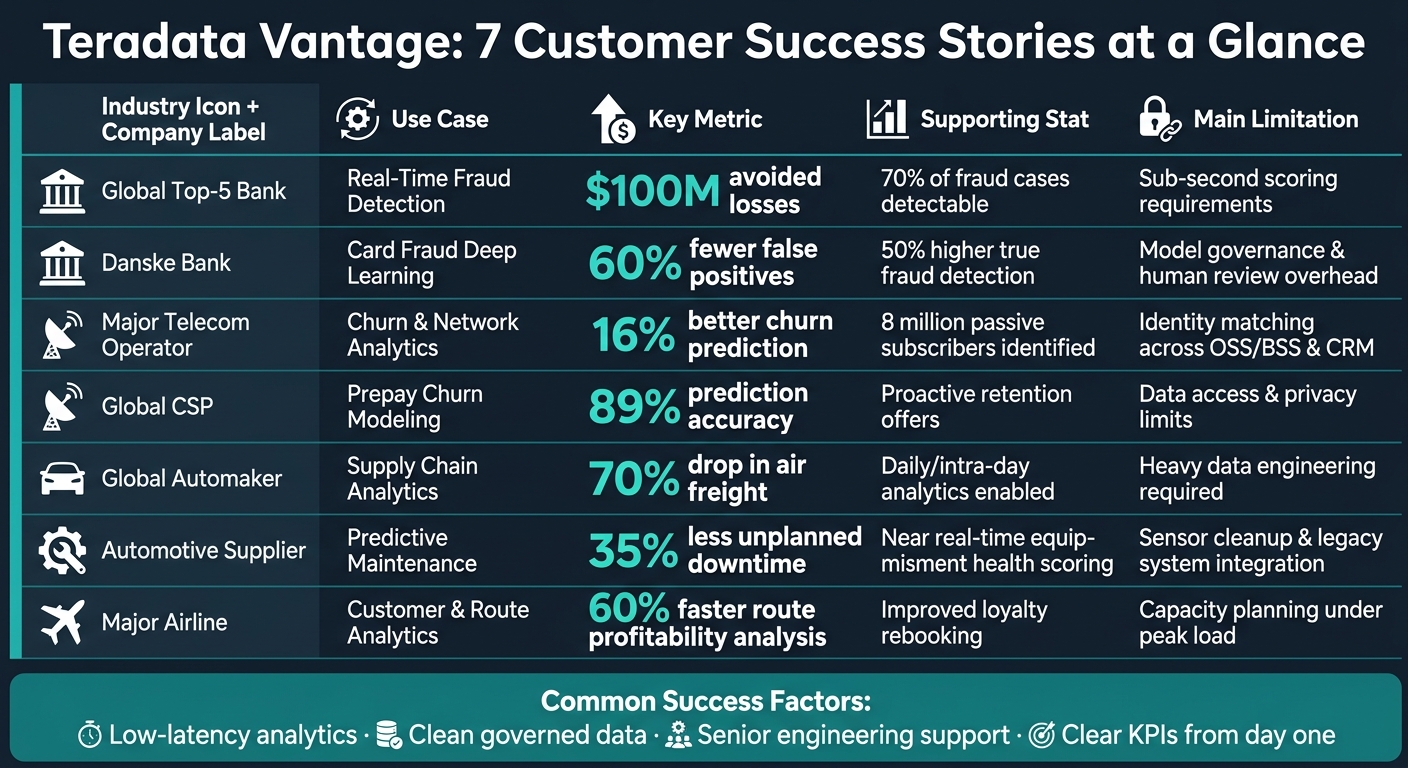
Teradata Vantage: 7 Customer Success Stories by Industry & Results
Integrating Data in Teradata Vantage – A Case Study on Delivering Business Insights During COVID-19
sbb-itb-fd683fe
Quick Comparison
| Story | Industry | Main use case | Measured result | Main limit |
|---|---|---|---|---|
| Global Top-5 Bank | Banking | Remote access takeover fraud | 70% of fraud cases detectable; $100 million avoided losses | Sub-second scoring needs |
| Danske Bank | Banking | Card fraud deep learning | 60% fewer false positives; 50% higher true fraud detection | Model review and oversight |
| Major Telecom Operator | Telecom | Churn and network analytics | 16% better churn prediction; 8 million passive subscribers found | Identity matching across systems |
| Global CSP | Telecom | Prepay churn modeling | 89% prediction accuracy | Data access and privacy limits |
| Global Automaker | Manufacturing / Logistics | Supply chain analytics | 70% drop in air freight | Heavy data engineering |
| Automotive Supplier | Manufacturing | Predictive maintenance | 35% less unplanned downtime | Sensor cleanup and plant system links |
| Airline | Aviation | Customer and route analytics | 60% faster route profitability analysis | Capacity planning under peak load |
I’d read these stories one way: focus on the problem, the setup, the measured result, and the limit. That gives you a fast way to judge whether the same pattern could work for your team.
7 Teradata Vantage Customer Stories by Industry
Banking and Financial Services: Fraud Detection and Cloud Modernization
Story 1 – Global Top-5 Bank: Real-Time Remote Access Takeover Fraud
A global top-5 bank saw a sharp jump in remote access takeover (RAT) fraud across its digital channels. During COVID-19, fraud volume climbed 15% as more customers shifted online. To respond, the bank used Teradata Vantage to analyze 250,000 customer journeys per hour in real time. Each session was scored for fraud risk based on behavioral signals, device fingerprints, and geolocation patterns.
The payoff was big: 70% of fraud cases became detectable and preventable, which translated to about $100 million in avoided losses.
The models ran in-database, which kept latency below one second and preserved full auditability.
Story 2 – Danske Bank: Deep Learning for Card Fraud
Before moving to a Teradata-powered deep learning setup, Danske Bank detected only about 40% of fraud. It also dealt with up to 1,200 false positives per day, and more than 95% of investigated cases turned out not to be fraud at all. After putting the deep learning model inside Vantage, the bank went from design to production in 5 months.
The results were hard to miss:
- 60% lower false positives, with a path toward 80%
- 50% higher true fraud detection
For credit unions, card issuers, and regional banks dealing with tight oversight, this case shows how a champion-challenger model can work in practice. New models are tested against current ones before full rollout, while human review stays in place for high-risk edge cases.
Both banking stories hinge on low-latency scoring. In telecom, that same setup gets used less for fraud and more for churn and customer experience.
Telecom and Digital Services: Churn Analytics and Customer Experience
Story 3 – Major Telecom Operator: Network Experience Analytics
A major telecom operator tied together 14+ network KPIs, including dropped call rates, throughput, and latency, with billing history, complaint records, and device data inside Teradata Vantage. The aim was simple: spot subscribers likely to churn before they called to cancel.
That analytics layer improved churn prediction accuracy by about 16%. It also identified around 8 million passive subscribers, or about 11% of the full customer base, by using network paging KPIs as a behavioral signal.
The project also linked planning work across product, sales, and network rollout teams. That led to better channel targeting and fewer complaints. Getting there took work, though. Identity matching across OSS/BSS and CRM systems required repeated schema cleanup and close governance across teams.
Story 4 – Global CSP: Prepay Churn Modeling
A global communications service provider used Teradata to combine network data with customer profiles for churn modeling among younger prepaid subscribers. The model reached 89% prediction accuracy, which let the operator step in with offers before high-risk users left. Privacy controls limited how much behavioral data outside partners could access.
The same pattern shows up again here: when speed and clean data come together, retention work can spill over into day-to-day operations and service quality.
Logistics, Manufacturing, and Aviation: Costing, Industrial AI, and Operations Analytics
Story 5 – Global Automaker: Dynamic Supply Chain Analytics
A global automaker, dealing with thousands of parts across overseas plants, struggled with high express shipping costs and slow detection of shipment deviations. The team used Teradata Vantage to bring transportation, supplier, pricing, and service data into one analytics layer. With faster visibility, planners could step in before air freight became the default option.
That shift led to a 70% drop in air freight, and analysts moved from monthly or weekly reviews to daily or intra-day analytics.
The hard part was stitching the data together. Transportation systems and supplier feeds needed heavy data engineering to standardize schemas and fix format mismatches. Teams with one central data source and clear ownership of logistics data will get results sooner.
Story 6 – Automotive Supplier: Sensor and Predictive Maintenance Analytics
An automotive parts supplier running sensor-heavy production lines had a costly problem: unplanned equipment downtime that threw off output schedules and pushed up maintenance spend. The team used Teradata Vantage time-series functions to aggregate high-frequency readings from IoT sensors and RFID tags in-database. One example: temperature readings were rolled up into 30-minute increments over a 2-hour window, without sending data into outside scripts.
Predictive maintenance models then scored equipment health in near real time. The result was a 35% reduction in unplanned downtime and fewer emergency maintenance dispatches.
The setup work was not small. Legacy historians, SCADA systems, and manufacturing execution systems had to be connected, noisy sensor data had to be cleaned, units had to be normalized, and proprietary formats had to be sorted out. Plant IT teams that prefer local tools can also push back on central platforms, which makes phased migration a practical path. Manufacturers with standardized sensor setups and IT support will move into production sooner.
Story 7 – Airline: Customer and Operations Analytics at Scale
A major airline needed to connect booking records, loyalty profiles, ancillary purchase history, and operating data such as on-time performance, load factors, and cancellations. The goal was to support route profitability decisions and give top-value passengers better rebooking during disruptions.
After deploying Teradata Vantage, the airline cut route profitability analysis time by 60%. It also improved rebooking priority for top-tier loyalty members during irregular operations, which directly lowered service recovery costs.
During peak disruption periods, query volume across large passenger and flight datasets put pressure on governance processes, so the airline needed dedicated capacity planning. This kind of setup fits airlines and travel companies that manage dense loyalty and operations data and need daily decision support.
Cross-Case Comparison: Results, Requirements, and Best Fit
Across the seven stories, Teradata Vantage worked best for teams dealing with large, messy, complex data environments that needed faster analytics, cleaner reporting, and a smoother path to modernization.
The strongest rollouts had a few things in common: high data volume, a clear need for decision-ready reporting, and enough senior engineering support to keep the work moving without getting stuck.
What ties these cases together isn't the industry. It's the need for low-latency analytics on large, high-value data that doesn't arrive in perfect shape.
Setup Patterns and Common Friction Points
When you line up the seven stories side by side, they fall into three main groups: real-time risk scoring, customer retention analytics, and operations optimization.
A lot of the successful rollouts began with moving legacy systems into a cloud-native platform. In high-volume analytics settings, strong data pipelines gave teams a way to manage large-scale processing without things falling apart.
The biggest pain points showed up in data engineering and cleanup. Teams had to fix schema issues and standardize formats before analytics could grow. That work also went better when senior data engineers were closely involved.
Comparison Table: Industry, Use Case, Results, and Constraints
| Story Cluster | Use Case | Results | Constraints |
|---|---|---|---|
| Banking (Stories 1–2) | Real-time fraud scoring and deep learning for card fraud | 70% of fraud cases detectable; 60% fewer false positives; 50% higher true fraud detection | Sub-second latency requirements; model governance and human review overhead |
| Telecom (Stories 3–4) | Churn prediction and network experience analytics | 16% improvement in churn prediction accuracy; 89% model accuracy for prepaid churn | Identity matching across OSS/BSS and CRM systems; schema cleanup across teams |
| Logistics, Manufacturing, and Aviation (Stories 5–7) | Supply chain visibility, predictive maintenance, and operations analytics | 70% drop in air freight; 35% reduction in unplanned downtime; 60% faster route profitability analysis | Legacy system integration; noisy sensor data; capacity planning under peak load |
These patterns line up directly with the buyer-fit signals in the next section. They sketch out a pretty clear picture of who Teradata Vantage fits best, and the next section breaks that profile down.
Who Should Consider Teradata Vantage
Across the seven stories, the same pattern shows up: Vantage works best when scale, governance, and low latency all matter at the same time. Teradata Vantage is a fit for organizations with petabyte-scale data, multiple analytics teams, and strict governance rules - cases where data complexity goes past what a standard warehouse can comfortably handle.
One of the clearest signs is simple: analytics work keeps getting stuck because teams can't get clean, governed access to the data they need. That kind of friction slows AI and machine learning work. It also creates problems when several groups need to use the same data and stay aligned.
This matters even more in regulated industries like banking, healthcare, and telecommunications. In those settings, row-level security, lineage, metadata, and compliance controls aren't optional. They're required. That's the same setup seen in the fraud, churn, and operations examples above.
Put plainly, these stories point to one buyer profile: organizations running large-scale, shared, governed analytics workloads. If your organization doesn't have large-scale data, shared analytics workloads, or strict governance needs, Teradata Vantage is probably more than you need.
Conclusion: Key Lessons From These 7 Customer Stories
Across these seven stories, one theme keeps showing up: Teradata Vantage works best in large, governed settings where low-latency analytics relies on centralized data. You can see that in every example here - fraud scoring at a global bank, churn modeling at a telecom operator, supply chain visibility at an automaker, predictive maintenance at an automotive supplier, and route profitability at an airline.
Another point came up again and again: results depended less on the platform alone and more on governance, clean integration, and disciplined implementation. The teams that handled this well did not treat rollout as just a software deployment. They treated it as a data governance effort from day one. Teams that set KPIs, access controls, and pilot criteria early tended to get better results.
Vantage is a strong fit for organizations dealing with large-scale analytics, strict governance, and complex integration needs. Smaller, simpler settings usually do not need this level of platform.
FAQs
Is Teradata Vantage a good fit for my company?
Teradata Vantage is a strong choice for large enterprises that need trusted AI and large-scale data analytics that can handle a lot of complexity.
It works especially well for regulated industries that need tight security, governance, and data sovereignty. And because it supports hybrid, cloud, and on-premises setups, companies can keep data inside their own firewalls while still getting real-time, AI-driven insights.
What do these success stories have in common?
They all focus on turning governed data people can trust into measurable business results. The goal isn’t just to store information. It’s to use that data to support decisions and drive action.
Across use cases like fraud prevention, natural language analytics, and knowledge management, success comes from solving specific business problems with data that can scale and stays accurate, accessible, and actionable.
What are the biggest implementation challenges?
The biggest challenges usually come down to two gaps: knowledge and integration.
On the knowledge side, many organizations don't have enough captured context around their data. That becomes a problem fast when they want to become agent-ready. To get there, teams need strong semantics and metadata. They also need to use the metadata and query logs they already have to figure out how ready their data stack is.
On the integration side, teams run into governed, always-on connection problems that don't just go away. Think expiring tokens, upstream changes, complex branching logic, and data pipelines that are unreliable or full of data quality issues.
Related Blog Posts
- 7 Best Self-Service BI Tools 2026
- ERP Integration for Demand Planning: Complete Guide
- Best Practices for IoT Event Stream Integration
- 10 Key Features in Data Catalog Software
More on StackRundown
Continue on the AI Tools hub, or read next: